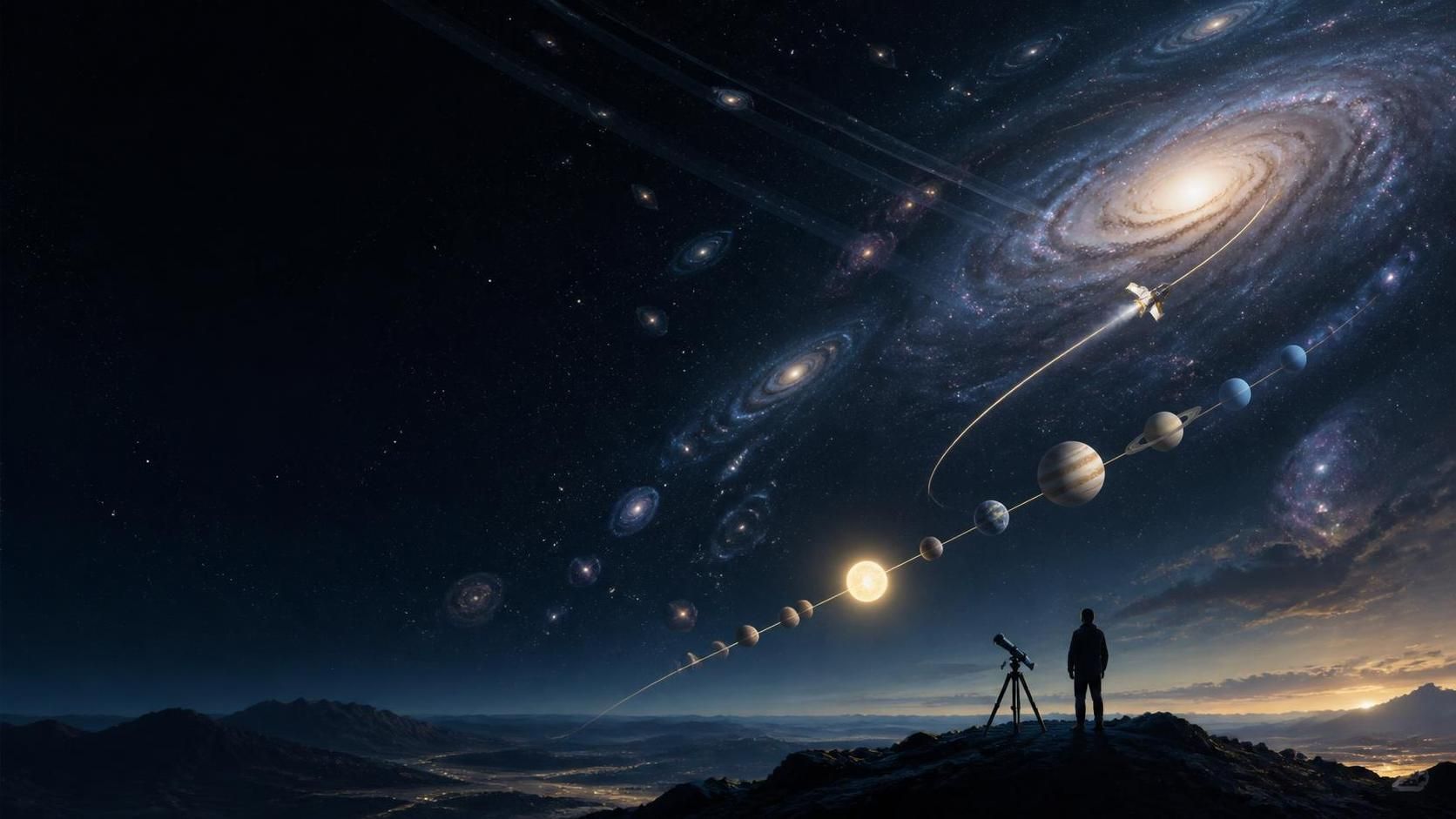
The second half of the opening journey through Carl Sagan’s Cosmos becomes increasingly concerned with movement: journeys between worlds, journeys through history and journeys into the past carried by beams of light.
The first five chapters established the foundations for this journey. Sagan introduced the scale of the universe, the history of scientific thought and the ways in which our view of the heavens has been shaped by both evidence and imagination. We travelled through the Solar System, from the familiar Earth to the hostile landscapes of Venus and Mars, and saw how easily our hopes can be mistaken for facts.
From chapter 6 onwards, the emphasis shifts. The planets remain important, but they become part of a much larger story. We begin to travel beyond individual worlds and consider the methods, people and ideas that allow us to explore the universe at all.
“Travellers’ Tales” is a fitting title for chapter 6 because exploration is at the heart of the human story. We often imagine exploration as something involving ships, maps and distant coastlines, but astronomy has always been another kind of exploration. The telescope became a vessel. Mathematics became a map. Light became the message sent across impossible distances.
This chapter connects naturally with the earlier discussions of Venus and Mars. Those worlds were once approached through speculation, with people imagining tropical landscapes, canals and alien civilisations. But as instruments improved, the planets became places that could be examined rather than merely imagined. The shift from fantasy to evidence is one of the central themes of Cosmos.
Sagan also reminds us that exploration is rarely the work of one person. Scientific knowledge is passed from one generation to another, and often from one culture to another. Discoveries are built upon older observations, revised calculations and ideas that may have travelled across continents and centuries. The history of astronomy is therefore not only a history of individuals, but of accumulated human effort.
The spacecraft that carry our instruments into the Solar System represent the physical continuation of that effort. They are small extensions of our senses, travelling where no human being has yet travelled. Through them, we can see the clouds of Venus, the surface of Mars and the distant outer planets. In a sense, these machines allow us to become present in places where our bodies cannot go.
Chapter 7, “The Backbone of Night”, widens the view dramatically. After spending so much time considering the planets, it is easy to forget that our Solar System is only a tiny neighbourhood within the Milky Way. The galaxy itself is the great structure behind the night sky, a vast collection of stars held together by gravity.
The phrase “backbone of night” captures something I have often felt when looking at the Milky Way. From a dark location, it appears almost like a faint cloud or a pale road stretching across the sky. Yet that soft band of light is made from enormous numbers of stars, many of them far larger and brighter than the Sun. Its delicacy is an illusion produced by distance.
Our Sun is not located at the centre of the galaxy, nor is the Milky Way the centre of the universe. This continues the lesson from the earlier chapters: Earth is not the centre of the Solar System, the Solar System is not the centre of the galaxy, and the galaxy itself is not the centre of everything. Each widening perspective removes another layer of human importance while revealing a much grander reality.
There is also a strong connection here with Sagan’s discussion of the ancient skies. The same band of stars that inspired myths and stories was eventually understood as a physical structure. The Milky Way changed from a heavenly mystery into a galaxy, but it did not become less beautiful. Scientific understanding adds depth to wonder rather than taking wonder away.
“Travels in Space and Time” moves from the structure of the galaxy to one of the most extraordinary consequences of living in such a large universe: when we look outwards, we look backwards in time.
Light does not arrive instantly. The sunlight we see left the Sun several minutes ago. The light from the nearest stars has travelled for years. When we observe distant galaxies, we see them as they were millions or billions of years in the past. The farther away we look, the further back into cosmic history we see.
This gives the universe a strange depth. The night sky is not a single moment displayed above us. It is a collection of different moments arriving together. Every star is showing us a different point in its history. Astronomy is therefore not merely the study of distant objects; it is a way of observing time itself.
The earlier chapters showed how difficult it is to understand the scale of space. This chapter makes time equally difficult to imagine. Human civilisation occupies only a tiny interval, and an individual life is smaller still. Yet the light reaching our telescopes may have begun its journey before Earth had taken its present form.
Sagan’s discussion of space-time also challenges the assumption that time passes identically everywhere. Since space and time are connected, motion and gravity affect how time is experienced. These ideas can feel abstract, but they reveal that the universe is not built according to ordinary human intuition. The rules we experience in daily life are only a small local expression of deeper laws.
By chapter 9, “The Lives of the Stars”, the journey has reached the universe as a whole. The questions are no longer about the climate of Venus or the possibility of life on Mars, but about the origin, scale and ultimate fate of everything that exists.
The idea of an expanding universe is especially striking. Galaxies are moving apart, and the farther we look, the more we see a cosmos that has changed over time. The universe is not static or eternal in the simple sense. It has a history, and that history can be investigated through the light reaching us from distant space.
Thinking about the beginning of the universe brings the first five chapters back into focus. The planets, the stars and the conditions that allowed life to appear are not separate subjects. They are stages in one long cosmic story. The Earth is connected to the stars, the stars to the galaxy and the galaxy to the beginning of the universe itself.
“The Lives of the Stars” also returns to the question of limits. Is the universe infinite? Does space have an edge? If the universe is expanding, what is it expanding into? These questions are difficult partly because our language was developed for everyday objects and distances, not for the totality of existence.
What I find most compelling about these chapters is that Sagan does not treat uncertainty as a failure. The unanswered questions are part of the adventure. We do not need to possess final answers before we can appreciate the importance of asking them.
Chapters 6 to 9 transform Cosmos from a tour of the Solar System into a journey through the structure and history of reality itself. We begin with spacecraft and explorers, move through the Milky Way, look back across immense distances of time and finally arrive at the origin and possible fate of the universe.
The journey leaves me with the feeling that space and time are not empty backgrounds behind existence. They are the great landscape in which every star, planet, civilisation and human life has unfolded. We are brief travellers crossing that landscape, carrying with us a remarkable ability to observe it, question it and occasionally understand a small part of its design.
Leave a Reply